1887 - TAG Heuer patents the oscillating pinion
Major improvement in the chronograph industry: TAG Heuer invented the famous 'oscillating pinion' for mechanical stopwatches. In 1887, the Oscilating Pinion was patented. It is still used to this day by leading manufacturers in sic production of mechanical chronographs and for example in the Calibre 1887, the fourth movement developed and produced in-house by TAG Heuer.
The Oscillating Pinion
1895 - Patent of the TAG Heuer water-resistant case
The patent for one of the first water-resistant cases for pocket watches.
Patent Of The TAG Heuer Water-resistant Case
1908 - Pulsometer dial patent
The company obtains a patent for a Pulsometer dial still used today by doctors.
Pulsometer Dial Patent
1910 - One of the first TAG Heuer patents
The first TAG Heuer patent
Edouard Heuer patented a keyless, crown-operated winding system for pocket watches.
First TAG Heuer Patents
1911 - Time of Trip
The 'Time of Trip', the first dashboard chronograph patented by TAG Heuer in 1911, was designed for aircraft and automobiles. Its 11-cm diameter and its size are well suited for installation on all types of dashboards. The large hands at the centre of the dial indicate the time. The small pair of hands, at the 12 o'clock position, give the duration of the trip (not exceeding 12 hours). The same button is used to start, stop and reset the clock. A small window at the 3 o'clock position serves to monitor the proper operation of the device.
Time Of Trip| TAG Heuer
1912 - Women's wristwatches
Heuer begins producing women's wristwatches.
Women's Wristwatches
1914 - The first wrist worn chronographs
Introduction of the brand's first wrist chronographs with a silver case, enamelled dial and luminous hands. This large wrist chronograph is fitted with the same mechanics, powered by a pocket watch movement. Its crown and integrated button for start, stop and reset are located at 12 o'clock.
The First Wrist worn Chronographs| TAG Heuer
1916 - Semikrograph and Semicrosplit accurate to 1/50th of a second
The 'Semikrograph' and the 'Semicrosplit' measure time to 1/50th of a second. The 'Semicrosplit' version can measure two events simultaneously thanks to its fly-back hand.
Semikrograph And Semicrosplit Accurate To 150th Of a second
1916 - Mikrograph and Microsplit: accurate to 1/100th of a second
TAG Heuer invents the 'Mikrograph' and the 'Microsplit', the world's first sports stopwatches with a precision of 1/100th of a second. The 'Microsplit' version can measure two events simultaneously thanks to its fly-back hand. These new developments revolutionized science, industry and watchmaking, and made TAG Heuer the natural choice as the official supplier of timing instruments for the 1920 Olympic Games.
Mikrograph And Microsplit Accurate to 1100th Of a second
1920 - Sports chronometers
This chronograph and these enamelled dial sports stopwatches are fundamental pieces of the collection. Top: split-second chronograph with fly-back hand. Left: sports stopwatch with two fly-back hands.
Sports Chronometers
1930 - Chronograph for pilots
In the 1930's, TAG Heuer is producing chronographs specially designed for pilots, with the same cases and dial as other pilots' watches of the period. Now the company introduces one-button and two-button versions. (These chronographs later inspired the Targa Florio chronograph, re-issued by TAG Heuer in 1996).
Chronograph For Pilots
1933 - The Autavia dashboard instrument
Creation of the first dashboard instrument for automobile and aviation : 'Autavia'(contraction of AUTomobile and AVIAtion). Later in 1933, TAG Heuer introduced the first dashboard featuring an 8-day movement, the 'Hervue' dashboard which ran for 8 days without winding
The Autavia Dashboard Instrument
1939 - Water-resistant wrist chronograph
Launch of a water-resistant wrist chronograph recognizable in their round push-buttons.
Water-resistant Wrist Chronograph
1948 - Auto-Graph
Launch of the 'Auto-Graph' model, a wrist chronograph with a tachometer scale and a manual reference hand. Launch of the 'Auto-Graph' model, a wrist chronograph with a tachometer scale and a manual reference hand.
Auto-graph
1949 - Solunar
Launch of the 'Solunar', the first watch with a tide indicator. It had an initial production run of 1,000 pieces.
Solunar
1950 - Mareograph
Launch of the 'Mareograph' - called the 'Seafarer' in the United States. The world's first chronograph with a tide level indicator and dial for regattas.
Mareograph
1955 - Twin-time
Introduction of the 'Twin-time' model, a self-winding wristwatch with a second time zone indicator. By pressing the push-button at the 2 o'clock position, the small hand can be moved separately to indicate the local time.
Twin-time
1960 - The Sebring
TAG Heuer launches the split-second 'Sebring' stopwatch around 1960.
The Sebring
1963 - The Film-Master in Hollywood
During the 1960's and the 1970's, the legendary 'Film-Master' model was used by Hollywood's most famous movie directors to time film sequences.
The Film-master In Hollywood
1964 - Launch of the 'Carrera' chronograph
Jack Heuer launches the 'Carrera' as a tribute to this exciting race 'Carrera Panamericana Rally' of the 50's: the first chronograph with a pure and functional dial design featuring a wide dial opening and a 1/5th of a second scale on the flange. This model rapidly becomes the watch of the champions and a best seller worldwide.
Launch Of The 'carrera' Chronograph
1966 - Mikrotimer: 1/1,000th of a second
TAG Heuer introduces a worldwide first: the 'Mikrotimer', the first miniaturized electronic timing instrument with a precision of 1/1,000th of a second.
Mikrotimer 11000th Of a second
1968 - The Camaro chronograph
Chronograph 'Camaro' with a hand winding movement, 1/5th of a second accuracy, 30-minute and 12-hour counters. Tachometer scale. Steel case. The name refers to the Chevrolet Camaro, a popular sports car.
The Camaro Chronograph
1969 - Autavia and Carrera automatic chronographs
Introduction in 1969 of the 'Autavia' and the 'Carrera' chronographs fitted with the 'Chronomatic'. On the left, the 'Autavia' model with a tachometer scale. On the right, the elegant 'Carrera' model. They also have a date display.
Autavia And Carrera Automatic Chronographs
1969 - Chronomatic with microrotor
Launch of the first automatic chronograph movement with a micro-rotor: the 'Chronomatic' (Calibre 11, rapidly replaced by the Calibre 12) was developed and launched by TAG Heuer in 1969. Three wrist chronograph models are fitted with the chronomatic: the 'Autavia', the 'Carrera'and the new 'Monaco'.
Chronomatic with Microrotor
1970 - Steve McQueen and his fabled 'Monaco'
A time of passion: the brand becomes a reference for Steve McQueen. He wore the 'Monaco' chronograph during the making of the film Le Mans in 1970, and became the brand's official worldwide ambassador.
Steve Mcqueen And His Fabled 'monaco'
1972 - The Temporada chronograph
Not everything that glitters is gold: the 'Temporada' was a chronograph housed in a plastic case that was painted gold and could only be opened from the dial side - an unusual style. The movement is a Valjoux 7733.
The Temporada Chronograph
1972 - Calculator
Model of the Calculator Series: Automatic chronograph, 1/5th of a second accuracy, 30-minute counter, date at 6.
Calculator
1972 - The Montreal chronograph
The characteristic of the 'Montreal' model is the cushion-shaped case that was so popular in the 1970's and 1980's. The name refers to the Canadian race track.
The Montreal Chronograph
1974 - The Silverstone chronograph
Launch of the 'Silverstone': an automatic chronograph with 1/5th of a second accuracy, 30-minute and 12-hour counters, date, with a chronomatic movement. The name refers to the famous english race track.
The Silverstone Chronograph
1975 - Microsplit with LCD display
The 'Microsplit', the world's first LCD pocket-size quartz stopwatch accurate to 1/100th of a second was invented and manufactured by TAG Heuer, designed by the famous designer Richard Sapper
Microsplit With Lcd Display
1976 - The Daytona chronograh
The automatic Chronograph 'Daytona' was a successful model fitted with a development based on the first automatic chronograph movement, Calibre 11. Its characteristics are: 1/5th of a second accuracy, 30-minute and 12-hour counters, date and tachometer scale. The name refers to the american race track.
The Daytona Chronograh
1977 - The Chronosplit Manhattan GMT
Launched in 1977, the 'Chronosplit Manhattan GMT' is the world first chronograph combining analogic and digital displays.
The Chronosplit Manhattan GMT| TAG Heuer
1982 - 2000 Series
Launch of the '2000 Series', the original Professional Sports Watch with the famous 6 features created in 1982: water-resistance to 200 meters, Screw-in crown, Unidirectional turning bezel, Sapphire Crystal, Luminous hands and hours markers, Double safety clasp.
2000 Series
1986 - The Formula 1 series
Launch of the TAG Heuer Formula 1 which combines steel and fiberglass.
The Formula 1 Series
1987 - Six Features
Introduction of the Six Features advertising campaign using the famous photo of Ayrton Senna: 'Champagne-resistant to 200 meters'.
Six Features
1997 - Launch of the Kirium
Launch of the 'Kirium' series, an exceptional line embodying a fusion of form and function through a judicious combination of technology and design.
Launch Of The Kirium
1999 - Launch of the Alter Ego
Launch of the first TAG Heuer watch exclusively dedicated to women: 'Alter Ego'. Among the 5 new women ambassadors endorsing the new Alter Ego series, 3 world class champions and 2 world famous actresses: Kristen Scott Thomas and Helena Bonham Carter
Launch Of The Alter Ego
2000 - Launch of the Kirium Ti5
Launch of the first ever polished watch with a special alloy of titanimum (Ti5) coming from McLaren F1 factories: the Kirium Ti5.
Launch Of The Kirium Ti5
2001 - Monza Calibre 36
Presentation of the Classics chronograph Monza Calibre 36. The exceptional Calibre 36 automatic movement is capable of measuring time to 1/10th of a second.
Monza Calibre 36
2001 - Launch of the Kirium F1
Crafted for the avant-garde, the TAG Heuer 'Kirium Formula 1' is a feast of technical achievements: The modern analog watch with digital chronograph functions, accurate to 1/100th of a second.
Launch Of The Kirium F1
2003 - Mikrotimer: 1/1,000th of second
Launch of the 'Mikrotimer': the first Swiss Wrist Timekeeping Instrument accurate to 1/1,000th of a second.
Mikrotimer 11000th of second
2003 - Monaco Sixty Nine
Launch of the 'Monaco Sixty Nine': TAG Heuer reinvents its icon. With its extraordinary technical performance, this 'concept watch' combines in one and the same case the Monaco's manual-winding movement with a digital chronograph movement on the reverse side. In 2004, the 'Monaco Sixty Nine' wins the Best Design Prize at the Geneva Grand Prix d'Horlogerie.
Monaco Sixty Nine
2004 - The V4 concept watch
TAG Heuer touched off a true revolution in watchmaking circles with the launch of the new 'Monaco V4' Concept Watch at Baselworld 2004. As the first mechanical movement of the third millennium, its operation involves the use of belts, a linear weight, ceramic ball-races and four V-mounted barrels. Its bold design reflects this revolutionary technology.
The Monaco V4 Revolution
2004 - Indy 500 chronograph
Indy 500 chronograph': the exclusive chronograph showing TAG Heuer's involvement with IRL and the Indy 500. Since 2004, TAG Heuer is the Official Timekeeper of the Indy Racing League and Indy 500 Race, and masters the challenge of measuring 1/10,000th of a second.
Indy 500 Chronograph
2004 - 2000 Aquaracer
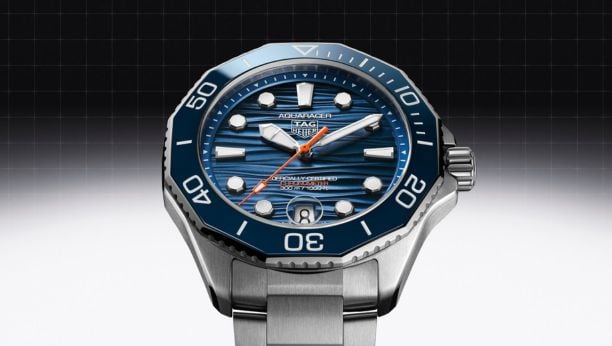
TAG Heuer launches the '2000 Aquaracer', the high-tech and design professional water sports watch for dress-up or dive-deep.
2000 Aquaracer
2005 - Professional Golf Watch
Launch of the first ever professional golf watch, the Professional Golf Watch. It would go on to win a Chicago Athenaeum Good Design Award (2006) and a FENNIA Design Award (2007).
Professional Golf Watch
2005 - Creation of the Calibre 360
Launching its Calibre 360, the very first mechanical wrist chronograph accurate to 1/100th of a second, TAG Heuer again demonstrates its avant-garde spirit and precision craftsmanship in mechanical watchmaking.
Creation Of The Calibre 360
2006 - The Carrera Calibre 360 Rose Gold
Produced in a limited edition, the Carrera Calibre 360 Rose Gold wins the Sports Watch prize at the Geneva Grand Prix d'Horlogerie.
The Carrera Calibre 360 Rose Gold
2006 - Monaco Calibre 360 LS
Introduction of the Monaco Calibre 360 LS (Linear Second) Concept Chronograph at Baselworld.
Monaco Calibre 360LS
2007 - Grand CARRERA by TAG Heuer
On the occasion of the DREAM MACHINES DRIVEN BY GENEROUS HEARTS project, TAG Heuer introduced the new Grand CARRERA by TAG Heuer. It is powered by the exclusive TAG Heuer Calibre RS automatic movements, the first mechanical line of movement engineered with rotating system indicators. Among its many premium features is the ingenious GT car engine-inspired Rotating System, making it possible to replace conventional hands with a disk displaying even clearer functional information on the dial.
Grand CARRERA By TAGHeuer| TAG Heuer
2007 - Link Calibre S
With an electro-mechanical movement, the Calibre S combines the precision of quartz with the sophistication of mechanical functions. Its bi-directional motors make it so simple to use and read that it is the natural, avant-garde 'driver' of the new Link Calibre S.
Link Calibre S
2008 - Grand Carrera Calibre 36 RS Caliper
TAG Heuer sets a new milestone by integrating its latest Concept Chronograph, the Grand CARRERA Calibre 36 RS Caliper, into the dashboard of a Ken Okuyama-designed and TAG Heuer-inspired GT sportscar.
GC Calibre 36 Caliper Concept Chronograph
2010 - Pendulum
TAG HEUER PENDULUM CONCEPT: A POTENT NEW TECHNICAL MILESTONE IN MECHANICAL MOVEMENTS
The TAG Heuer Pendulum Concept is the first-ever magnetic oscillator without hairspring capable of providing a restoring torque comparable to that of a hairspring: the basic principle of the Swiss anchor escapement is therefore unchanged, but the absence of mass and therefore inertia allows for much larger frequencies. Theoretical precision is significantly higher as it is possible to oscillate at small angles (the elementary principle of oscillator accuracy) without altering the return torque and, especially important, without causing geometric deformations.
Pendulum
1957 - The Ring Master, a worldwide first
Launch of the 'Ring Master' stopwatch - a world first - interchangeable rings of scale for timing various sports with readings down to 1/5th of a second, central minute-hand.
The Ring Master, A Worldwide First
1973 - Accuracy to 1/100th of a second
The company introduces the Microsplit 820 the world's first quartz, pocket-sized sports timer (solid-state and digital display) accurate to 1/100th of a second.
Accuracy To 1/100th Of A Second
2002 - 'Oracle BMW Racing' - Louis Vuitton Cup
TAG Heuer sponsors Chris Dickson, Peter Holmberg and the Oracle BMW Racing team, the Americas Cup challenger, during the Louis Vuitton Cup.
'Oracle BMW Racing' - Louis Vuitton Cup
1860 - Edouard Heuer
At the age of twenty, Edouard Heuer sets up a watchmaking workshop in St.Imier in the Swiss Jura region.
Edouard Heuer
1876 - English subsidiary establishment
Edouard Heuer establishes a subsidiary in London.
English Subsidiary Establishment
1883 - TAG Heuer at the Amsterdam International Exhibiton
The company wins a silver medal at the International Exhibiton in Amsterdam.
TAG Heuer At The Amsterdam International Exhibiton
1887 - Edouard Heuer's son becomes part of the management.
Edouard Heuer's son, Jules-Edouard becomes part of the management.
Edouard Heuer'son
1888 - Jules-Edouard Heuer
The company is awarded a patent for a repeater watch with automatic chiming.
Jules-edouard Heuer
1889 - TAG Heuer at the Paris World Fair
TAG Heuer wins a silver medal at the Universal Exhibition in Paris, for its collection of pocket chronographs.
TAG Heuer At The Paris World Fair
1891 - Charles-Auguste Heuer
Charles-Auguste Heuer joins the company after working in London at Edwin V. Streeter Ltd, an authority in semi-precious stones, and obtaining a diploma in gemology.
Charles-auguste Heuer
1892 - Edouard Heuer death
Edouard Heuer dies on April 30th, at the age of fifty-two.
Edouard Heuer Death
1910 - The american market
Henri Freund & Bros. takes on the distribution of Heuer products for the American market.
The American Market
1923 - Hubert Heuer
Hubert Heuer, the youngest son of Charles-Auguste Heuer, joins the company at the beginning of the year as U.S. commercial director.
Hubert Heuer
1924 - Timekeeper of the Paris Olympic Games
Paris Olympic Games: TAG Heuer split second pocket chronographs were selected as official stopwatches used at the Olympic Games on 3 consecutive occasions: Antwerp in 1920, Paris in 1924, Amsterdam in 1928.
Timekeeper Of The Paris Olympic Games
1928 - Timekeeper of the Amsterdam Olympic Games
Amsterdam Olympic Games: TAG Heuer split second pocket chronographs were selected as the official stopwatch used at the Olympic Games on 3 consecutive occasions: Antwerp 1920, Paris 1924, Amsterdam 1928.
Timekeeper Of The Amsterdam Olympic Games
1931 - Professor Auguste Piccard wears a TAG Heuer
The city of Biel presents Professor Auguste Piccard with a gold TAG Heuer chronograph, fitted with a 17-line movement, in commemoration of his balloon flight into the stratosphere with Biel physicist Kipfer.
Professor Auguste Piccard Wears A TAG Heuer
1934 - The Basel Watch Fair 1934
TAG Heuer participates for the first time at the Basel Watchmaking Fair.
The Basel Watch Fair 1934
1945 - General Eisenhower wears a TAG Heuer
General Eisenhower buys a TAG Heuer chronograph with a steel case.
General Eisenhower Wears A TAG Heuer
1947 - TAG Heuer worn by the world's elite
Prince William of Sweden and Harry S. Truman each wear a gold TAG Heuer chronograph.
TAG Heuer Worn By The World's Elite
1958 - Jack Heuer
Jack Heuer, Charles-Edouard Heuer's son, joins the company.
Jack Heuer Watch History
1959 - The american subsidiary
Jack Heuer sets up the Heuer Timer Corporation as a subsidiary in the USA.
The American Subsidiary
1962 - The first Swiss watchmaker to go into space
TAG Heuer becomes the first Swiss watchmaker to go into space. On February 20, John Glenn makes the first manned American space flight, orbiting the Earth three times in five hours. On his wrist is a Heuer stopwatch.
The First Swiss Watchmaker To Go Into Space
1965 - Evolution of the Carrera
TAG Heuer improves the 'Carrera' model with a major innovation: this model was the world's very first wrist chronograph with a digital date display printed on a disc (top). It supplements the traditional 'Carrera' model fitted with a 12-hour register and with a second hand register (below).
Evolution Of The Carrera
1967 - Emil Mosbacher's 'Intrepid' - America's Cup
Intrepid and its skipper Emil Mosbacher win the America's Cup with Heuer chronographs on board.
Emil Mosbacher's 'intrepid' - America's Cup
1970 - Clay Regazzoni
The famed Team Ferrari driver, Clay Regazzoni, wears the brand's logo on his driving suit.
Clay Regazzoni
1971 - Ferrari chooses TAG Heuer
As sponsor and official timekeeper of Team Ferrari from 1971 to 1979, TAG Heuer was associated with all of its legendary drivers: Jacky Ickx, Clay Regazzoni, Mario Andretti, Carlos Reutemann and Jody Scheckter. In his Ferrari, Niki Lauda won the drivers' championships world title in 1975 and 1977.
Ferrari Chooses TAG Heuer
1978 - Olympic Games in Lake Placid and Moscow
As part of the Swiss Timing organisation, TAG Heuer was asked once more to be one of the Official Timekeepers of the Olympic Games in Lake Placid and Moscow in 1980. For this occasion, TAG Heuer launches a special edition of the Microsplit that is the official stopwatch of the 1980 Olympic winter Game.
Olympic Games In Lake Placid And Moscow
1985 - Mike Birch's 'Formule TAG' - Route du Rhum
The fabulous multihull, the 'Formule TAG', skippered by Mike Birch, and one of the first Kevlar and carbon fibre trimarans, set a 24-hour speed record. In 1986, he is in 4th place of the Route du Rhum with the Tag Heuer multihull.
Mike Birch's 'formule TAG' - Route Du Rhum
1987 - The 'S/el'
TAG Heuer launches the 'S/el series' combining sports and elegance. This TAG Heuer model is most representative of the brand's success, with its exclusive design featuring a distinctive S-shaped link bracelet.
The 's/el'
1988 - TAG Heuer ambassador Ayrton Senna
Ayrton Senna becomes a TAG McLaren Mercedes driver and TAG Heuer ambassador. Thanks to his charisma, this multiple world champion, who became the representative of the 'S/el series', was a TAG Heuer ambassador for many years.
TAG Heuer Ambassador Ayrton Senna
1989 - Timekeeper of the Ski Federation World Cup
In 1989, TAG Heuer became the official timekeeper for the Ski World Cup and supplied timekeeping devices to the American and Canadian federations.
Timekeeper Of The Ski Federation World Cup
1991 - Don't crack under pressure
The Don't crack under pressure campaign is a tribute to both the brand's and its ambassadors' determination. It illustrates the pressure of sports and the intense concentration required of athletes in view of the fact that the practice of sports is more mental than physical.
Don't Crack Under Pressure
1992 - Official timekeeper of Formula 1
TAG Heuer becomes the Official Timekeeper of the FIA (Fédération Internationale de l'Automobile) Formula One World Championships.
Official Timekeeper Of Formula 1
1993 - Titouan Lamazou's 'TAG Heuer' - Jules Verne Trophy
The largest composite racing monohull ever built, christened the 'TAG Heuer' and built for French skipper Titouan Lamazou during the 'Jules Verne Trophy', was a precedent-setting project in both sporting and technological terms.
Titouan Lamazou's 'TAG Heuer' - Jules Verne Trophy
1994 - New Basel booth
TAG Heuer unveiled a daring new exhibition booth at Baselworld 1994. Created by Italian architect Ottavio di Blasi, the arch-shaped stand, the first building in the world with a carbon fiber structure, reflected not only the brand's commitment to avant-garde design and aesthetics, but also many of its key values, including balancing modernity with tradition, and tension with force.
New Basel Booth
1995 - Chris Dickson's 'TAG Heuer Challenge' - America's Cup
TAG Heuer introduced its own crew in the America's Cup with Chris Dickson (NZ) and the 'TAG Heuer Challenge'. Then, in 1997, the company again sponsors Chris Dickson in the Whitbread round-the-world race.
Chris Dickson's 'TAG Heuer Challenge' - America's Cup
1995 - Success - It's a mind game
Success. It's a mind game: TAG Heuer invents a prestigious and spectacular campaign based on the world of sports as never before portrayed, creating a firm foundation for the brand's positioning in the luxury sector. This TAG Heuer campaign won 15 of the world's most prestigious advertising awards. Sports figures are no longer seen as merely positive 'subjects', but also convey an up-to-date image of success.
Success - It's A Mind Game
2001 - Jack William Heuer
Jack Heuer becomes Honorary Chairman of TAG Heuer.
Jack William Heuer
2002 - Sport Vision
TAG Heuer launches the '2002 Sport Vision': the first luxury sports glasses. 'Sport Vision' is an ergonomically designed line of prescription eyewear and sunglasses. Its avant-garde design inspires technology, and technology determines function.
Sport Vision
2002 - The F1 Mikrograph wins the Design Watch prize
The 'Mikrograph F1' wins the Watch Design Award at the Geneva Grand Prix d'Horlogerie. TAG Heuer reinvents the 'Mikrograph', the world's first sports stopwatch with 1/100th of a second precision, patented in 1916.
The F1 Mikrograph Wins The Design Watch Prize
2002 - What are you made of?
The What are you made of? campaign becomes a symbol of the brand's prestigious avant-garde stance and the TAG Heuer spirit. The campaign's key concepts are sports inspiration, avant-garde watchmaking, sophistication and identification. Ayrton Senna, Steve McQueen and Inès Sastre lend their images to this campaign.
What Are You Made Of?
2003 - Timekeeper of the FIS World Championship
TAG Heuer is the Official Timekeeper of the 2003 FIS Alpine Ski World Championships in St Moritz.
Timekeeper Of The Fis World Championship
2007 - The new Basel booth
To mark the 20th anniversary of the LINK series, TAG Heuer has once again called upon Ottavio di Blasi to design a Baselworld booth that embodies the brand's unique vision and drive. The result is the breathtaking 'TAG Heuer SKIN', celebrating the union of technology and design.
The New Basel Booth
2007 - Lewis Hamilton joins TAG Heuer
The new McLaren Mercedes Vodafone driver Lewis Hamilton becomes a TAG Heuer ambassador.
Lewis Hamilton Joins TAG Heuer
2007 - Fernando Alonso joins TAG Heuer
The new McLaren Mercedes Vodafone driver Fernando Alonso becomes a TAG Heuer ambassador.
Fernando Alonso Joins TAG Heuer
2008 - TAG Heuer 360 museum
TAG Heuer unveils his new exhibition area, the TAG Heuer 360 museum, a historical and avant-garde gallery dedicated to the glory of its exceptional heritage. Inaugurated in La Chaux-de-Fonds on January 30th, 2008, during a ceremony attended by Lewis Hamilton and many other personalities, this location offers visitors a unique audiovisual experience. Distinguished both by its architectural concept and by its circular scenography, it exhibits 150 years of a watchmaking saga dedicated to mastering infinitely small times. Visitors will discover the technological and aesthetic innovations applied to sports timekeeping as well as to wristwatches, and which have represented major milestones in the history of Swiss watchmaking.
TAG Heuer 360 Museum